 Christian Beatty
A client cancels, and the team is surprised. Last month, there was no sign of a problem. When the cancellation email arrives, it is too late to save the client.
But the signs were there for weeks before the cancellation. A card payment failed. Nobody replied to a client email. Two deliverables were late. Each sign was in a different tool: billing, the inbox, or the project board. Nobody examined all of these tools at the same time.
This post describes the risk score that I made for a local SEO agency with approximately 85 clients. It shows the signals that the risk score monitors and the points for each signal. It also shows what the team does when a client is at risk. At the end, there is a spreadsheet version that you can start this week.
Clients do not cancel without signs
When a client cancels, the reason is usually one of these:
Cash flow or price
No visible results
Slow communication
The card failed, and the client did not correct it
The client moved the work to an in-house team
The business closed
Almost all of these reasons give a sign before the cancellation. For example:
A failed card shows in billing weeks before the client cancels.
Slow communication shows in the inbox as a client email with no reply.
Late deliverables usually occur before a client complains about "no visible results."
The signs are there, but they are in four or five different tools. No person has the job to monitor all of these tools. Because of this, the owner must do it, and the owner does it only when they remember.
What a risk score is
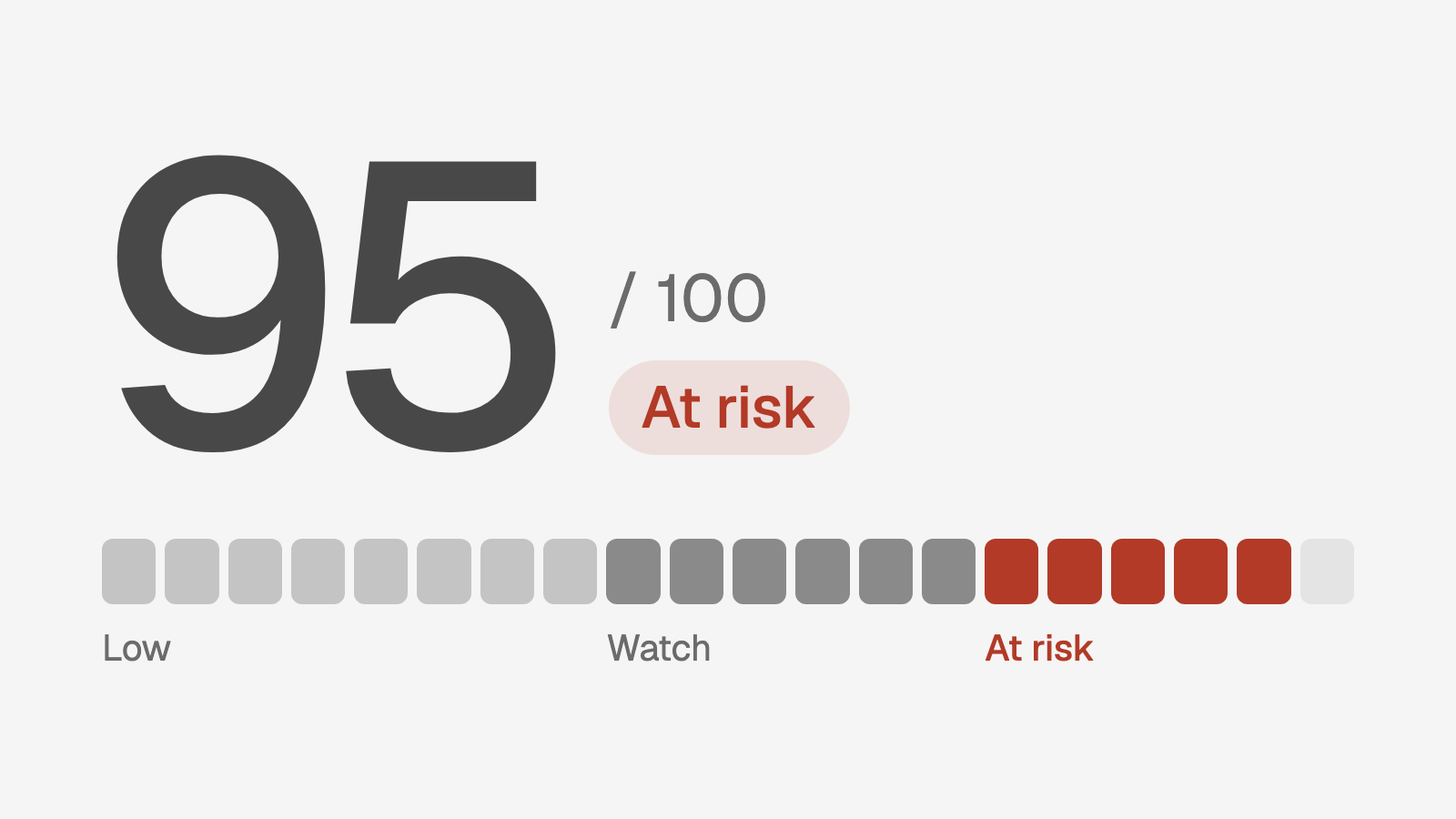
A risk score is one number for each client, from 0 to 100. The system calculates the risk score again each morning. A high number shows that the client possibly will cancel. Below the number, there is a list of the reasons, with the points for each reason.
0 to 39: low risk
40 to 69: watch
70 to 100: at risk
This is an example of one client:
Summit Roofing: risk score 95, at risk
Invoice of $3,600 due Oct 3 is not paid (+40)
Client email "Question about the October report" has no reply for 8 days (+30)
Month 3 as a client: the highest-risk period (+25)
This is a sample client. The names and numbers in this example are not real.
You can read the card and know what to do:
Ask the client to pay the invoice.
Reply to the email.
Call the client. Month 3 is when many clients decide if they will stay.
The signals and their points
The table shows the signals that the risk score monitors. The system adds the points together. The maximum risk score is 100.
Signal | Points |
|---|---|
The newest invoice is not paid 3 or more days after the due date | 40 (15 for an older invoice) |
An active client has no scheduled invoice and no payment in the last 35 days | 35 |
A client email has no reply | 20 after 2 days, 30 after 7 days |
An invoice was refunded or cancelled, and no new invoice replaced it | 30 |
Deliverables are overdue | 15 for 1 or 2, 25 for 3 or more, plus 5 if one is 14 or more days late |
No email in either direction | 15 after 30 days, 25 after 60 days |
Time as a client | 15 in month 1, 25 in months 2 and 3, 10 in months 4 to 12 |
The client is paused | 20 |
The client did not send an item that the team asked for (access, approval, or content) | 10 after 14 days, 20 after 30 days |
The client paid 5 or more days late on 2 of the last 3 invoices | 10 |
The reviewer sent a deliverable back in the last 60 days | 10 |
Payment signals have the most points
An unpaid invoice is the strongest signal. Sometimes the card is expired. But sometimes the client decided to cancel and lets the payment fail. In both cases, a person must call the client that week.
The signal "no scheduled invoice" finds two different problems. The client possibly plans to cancel and did not tell you. Or the team does the work but did not send an invoice. You must know about both problems on the same day.
A client email with no reply is the clearest communication signal
A client asks a question and waits one week for an answer. This is the "slow communication" cancel reason, as it occurs. Because of this, an email with no reply has a maximum of 30 points. That is more than 60 days with no email.
Silence can be normal. A question with no answer is never normal.
Two rules keep this signal fair:
The risk score does not count silence in the first month of a client.
The risk score counts silence only for clients who use email. A client who uses the phone does not receive points for silence.
Months 2 and 3 have the highest risk
At this agency, 9 to 12 percent of clients in month 2 or 3 cancelled each month. After month 3, this decreased to approximately 6 percent. After one year, it decreased to less than 5 percent.
In the first months, the client paid but did not see results yet. The client still decides if your agency is worth the money.
Because of this, time as a client is a signal by itself. Give a new client with one late deliverable more attention than a client of three years with the same problem.
Delivery problems occur before results problems
Overdue deliverables are an early sign of "no visible results." Deliverables that the reviewer sent back are also an early sign. If the work is late, the results are also late. The client does not see your deliverables. The client sees only the results.
The signal "the client did not send an item" is the opposite problem. The team asked for access or an approval, and the client did not send it for a month. This client is less engaged. The work stops until the client replies.
Why the risk score uses rules, not AI
Each point in the risk score comes from a rule that you can read. This was intentional.
The agency has approximately 85 clients. That gives too few cancellations to train an AI model that you can trust. Also, an AI model can say "72 percent probability to cancel." But that does not tell the team what to do. The text "Invoice of $3,600 due Oct 3 is not paid" tells the team what to do.
Rules are also easy to change. For example, the team can decide that a paused client receives 10 points, not 20. The team changes one number. The next morning, the full list shows the change.
AI has a function here, but not as the judge. For example, AI reads each client email with no reply and flags it if it is a complaint. Before a person calls the client, AI writes a summary of the last three months of messages. A person always reads the result and makes the decision. The rules are the base. AI runs on top of the rules.
Test the risk score on clients who cancelled
The points in this post are a first estimate. To make them more accurate, calculate the risk score for dates in the past.
Make a list of all clients who cancelled in the last year.
For each client, calculate the risk score for the date 30 days before they cancelled.
Calculate the risk score again for the date 60 days before they cancelled.
Count the clients that had the level "watch" or "at risk."
If most of these clients had a high risk score, the risk score monitors the correct signals.
Then examine the risk scores of your current clients. If 20 current clients are at risk, the team will not act on all of them. Increase the thresholds until the list is short. The team must be able to call each client on the list in one week.
A risk score that shows all clients as at risk is not useful.
What the team does when a client is at risk
A risk score is useful only if the team acts on it. When a client is at risk, the system adds a save flow to the client automatically. The save flow has one person in charge and these steps:
Examine the client record: payments, reports, results, messages, overdue deliverables, notes, and time as a client.
Find the possible cause. Use the list of cancel reasons above.
Contact the client personally in 2 business days or less. Call first. If the client does not answer, send a text or an email.
Listen to the client before you offer a solution.
Offer a solution for the cause. For example, show the results, correct the late deliverable, or update the card. You can also change the scope or the price, or offer a pause.
Record the result: saved, paused, or cancelled. If the client cancels, record the reason.
Contact the client again after 2 weeks and after 30 days.
Many agencies do not do step 6. But step 6 makes the risk score better. Each reason that you record makes the next test more accurate.
Start this week with a spreadsheet
You can do a simple version of this in a spreadsheet. It takes approximately 15 minutes each Monday.
Make one row for each active client.
Add these columns:
Months as a client
Newest invoice paid (yes or no)
Days since the last email in either direction
Days that a client email has no reply
Number of overdue deliverables
Days since you asked the client for an item
Give points to each row. Use the points in the table above.
Sort the rows from the highest risk score to the lowest risk score.
Call the three clients with the highest risk scores this week.
A spreadsheet is not as current as a risk score that the system calculates each morning. But it shows you clients that you possibly will lose. When the spreadsheet shows its value, make the process automatic.
How does your agency score?
Client retention is one of eight areas in the free agency systems quiz. The quiz has 14 questions and takes 5 minutes. You receive a score out of 100 and your three largest gaps.
Take the 5 minute quiz. Or book a call, and I will show you how a system like this can work in your agency.