 Christian Beatty
You pay for ads, for cold calls, and for events. New clients arrive each month. But when you ask which channel brings clients that are worth the cost, nobody can tell you. The ad dashboard shows leads. The CRM shows won deals. The billing tool shows payments.
Because of this, the budget decision is a guess. The channel with the most leads receives more money. The channel that brings clients who stay for two years is not visible. Possibly your most expensive channel loses money, and you do not know it.
This post shows how to calculate LTV:CAC for each acquisition channel in a marketing agency. It uses the sample numbers from the demo on my site. It also shows the data that your systems must hold. At the end, there is a spreadsheet version that you can start this week.
Why you cannot see which channel works
This is a data problem, not a people problem. The three facts that you must have are in three different tools, and nothing connects them.
The source of the lead is in the CRM or the ad platform. Often, nobody records it.
The cost of each channel is in ad accounts, payroll, and invoices from contractors.
The value of each client is in the billing tool. It increases each month that the client stays.
The source is the first fact that you lose. A lead completes a form, a sales person calls, and the deal moves through the pipeline. When the team marks the deal as won, the source field is often empty. When the team creates the client record in the ops system, nobody copies the source. After that, you cannot connect a payment to a channel.
The second problem is time. You pay the cost of a channel this month. The value of a client arrives over one or two years. A monthly "cost per lead" report cannot show which channel brings clients who stay.
The two numbers, defined for an agency
LTV: what a client pays over the full time with you
LTV (lifetime value) is the total amount that one client pays your agency, from the first invoice to the last invoice. For a retainer agency, the simple formula is:
LTV = monthly fee multiplied by average months retained
A better version subtracts the delivery cost. This is gross-margin LTV. For example, a client pays $1,500 each month for 12 months. The revenue LTV is $18,000. If delivery costs 40 percent of the fee, the gross-margin LTV is $10,800. These are sample numbers.
The months retained come from your cancel rate. If 6 percent of clients cancel each month, the average client stays approximately 17 months (1 divided by 0.06). But the cancel rate is not the same each month. At a local SEO agency with approximately 85 clients, 9 to 12 percent of clients in month 2 or 3 cancelled each month. After that, the rate was approximately 6 percent. After one year, it was less than 5 percent.
Because of this, a formula with one cancel rate gives only an estimate. When you can, use the real number of months that each client paid. Also calculate LTV separately for each channel. Clients from different channels possibly stay for different times.
CAC: what it costs to win one client
CAC (customer acquisition cost) is all sales and marketing cost for a channel, divided by the number of clients won from that channel. Use the same period for both numbers, for example the last 12 months.
Count all the cost, not only the ad spend:
Ad spend and the fees of the tools for that channel
The time of the sales person who calls and meets those leads, at their hourly cost
Contractors and freelancers who run the campaigns
Referral fees, event tickets, and gifts for referral partners
For cold calls: the wages of the callers, the dialer, and the lists
Referrals are not free. They cost time, and they often cost fees. If you set their cost to zero, the ratio for referrals has no limit, and it tells you nothing.
The ratio and what it tells you
LTV:CAC is LTV divided by CAC. A ratio of 3x means that a client pays three times the cost to win that client. A common rule of thumb is 3x or more. The demo on my site uses these levels:
LTV:CAC | Level | What to do |
|---|---|---|
5x or more | Scale it | Put the next dollar of budget here. |
3x to 5x | Healthy | Keep it. Monitor the cost per client. |
2x to 3x | Watch | Improve the channel before you spend more. |
Less than 2x | Fix or cut | Fix the offer or the audience, or move the budget. |
An example with sample numbers
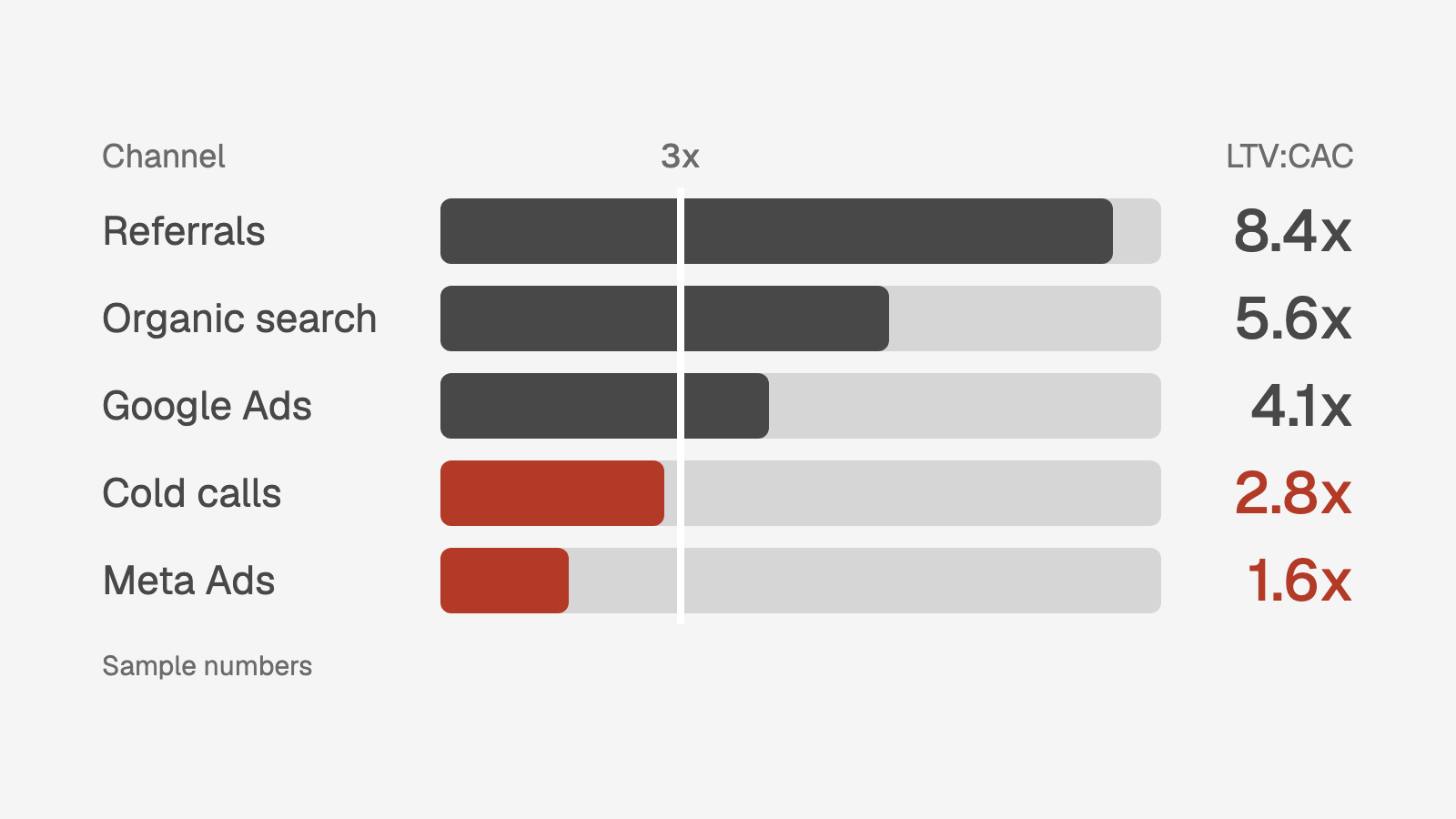
The table shows the five channels in the demo on my site. The numbers are invented sample data for 12 months. The LTV in the demo is revenue LTV.
Channel | Clients won | CAC | LTV | LTV:CAC | Level |
|---|---|---|---|---|---|
Referrals | 6 | $2,100 | $17,640 | 8.4x | Scale it |
Organic search | 5 | $3,200 | $17,920 | 5.6x | Scale it |
Google Ads | 7 | $4,300 | $17,630 | 4.1x | Healthy |
Cold calls | 4 | $6,400 | $17,920 | 2.8x | Watch |
Meta Ads | 6 | $10,900 | $17,440 | 1.6x | Fix or cut |
In this sample, the LTV is almost the same for each channel. The CAC is very different. Because of this, the cost to win a client decides the ratio. In your agency, the LTV can also be different for each channel. Measure both numbers.
Blended LTV:CAC is not the average of the channels
The blended ratio is the total value of all clients won, divided by the total cost to win them. In the sample, 28 clients have a total LTV of $495,170. The total acquisition cost is $149,700. The blended ratio is 3.3x.
The average of the five channel ratios is 4.5x. That number is wrong. It gives each channel the same weight. But Meta Ads used approximately 44 percent of all acquisition cost, and referrals used approximately 8 percent. The blended ratio counts each dollar one time, so it shows the real return.
Test a channel: what if you cut it?
A low ratio does not automatically mean that you must cut the channel. The demo has a "What if we cut it?" button. It calculates the blended ratio again without that channel. You can do the same calculation in a spreadsheet.
If you cut | Blended LTV:CAC | Fewer clients each year |
|---|---|---|
No channel | 3.3x | 0 |
Meta Ads | 4.6x | 6 |
Cold calls | 3.4x | 4 |
Referrals | 2.8x | 6 |
When you cut Meta Ads, the blended ratio increases from 3.3x to 4.6x. But you also win 6 fewer clients each year. That is approximately one in five new clients. Cut a channel only if you can replace those clients for less money.
Then do a second test with gross-margin LTV. On revenue LTV, the 6 clients from Meta Ads pay $104,640 in total. The cost to win them was $65,400. That looks positive. Now assume that delivery costs 50 percent of the fee.
With that assumption, the gross-margin LTV of these 6 clients is $52,320. That is less than the $65,400 that you paid to win them. On gross margin, the channel loses money.
Because of this, the definition of LTV is important. Use the same definition for all channels. With gross-margin LTV, all ratios decrease, and the 3x line is more difficult to reach. Before you cut a channel, examine the offer, the audience, and the time to reply to a new lead.
What the system must hold
You cannot calculate LTV:CAC by channel if your tools do not connect the data. The system must hold four things:
The source on the client record. Record it at first touch. Copy it to the won deal, and then to the client.
The monthly fee. The real payments of each client are better.
The start date and the end date. These give the months retained.
The spend for each channel, each month. Include wages, tools, and fees, not only ads.
Use one fixed list of sources, for example "Referral", "Organic search", "Google Ads", "Cold calls", and "Meta Ads". Make the field required in the CRM. A free text field gives you "google", "Google Ads", and "GAds" for one channel.
What the agency system holds
I built the ops platform for the local SEO agency. It records the source of each client and calculates LTV:CAC by channel. This is what it does:
When the team marks a deal as won in the CRM, a webhook creates the client record automatically.
The webhook message carries the name, the contact details, the website, the deal name, and the source.
The client record stores the source from one fixed list of sources.
Each client record has a monthly fee, a start date, an end date, a status, and a cancel reason.
An Industries tab groups all current and past clients by industry.
For each industry, the tab shows the average months paid, the average total paid, and the average monthly payment.
These numbers come from the real payments. One-time website projects are not in the numbers.
The Industries tab is the LTV half of the calculation, grouped by industry. The platform also groups the same payment data by source. A monthly table holds the spend for each channel. With the source, the payments, and the spend, the platform calculates LTV:CAC for each channel.
The calculations run on rules, integrations, and scheduled jobs. AI helps when a lead has no source. AI reads the first message from the lead and suggests a source. A person then examines each suggestion and accepts it or changes it.
Start this week with a spreadsheet
You can do a first version in one afternoon. Use the data from the last 12 months.
Make one row for each client that you won in the last 12 months.
Add a column with the source of each client.
If you do not know the source, ask the person who closed the deal.
Add the monthly fee and the number of months that each client paid.
For a current client, use the average months retained of your past clients.
Calculate the LTV of each client: monthly fee multiplied by months.
Make a second table with the total cost of each channel for the same 12 months.
Divide the cost of each channel by the number of clients from that channel. This is the CAC.
Divide the average LTV of each channel by the CAC of that channel.
Divide the total LTV of all clients by the total cost of all channels. This is the blended ratio.
Give each channel a level from the table above.
Then add a required source field to your CRM this week. In 12 months, the data will be complete. After that, the spreadsheet will show the real return of each channel.
How does your agency score?
Unit economics is one of eight areas in the free agency systems quiz. The quiz has 14 questions and takes 5 minutes. You receive a score out of 100 and your three largest gaps.
Take the 5 minute quiz. Or book a call, and I will show you how a system like this can work in your agency.